
Music begins with vibration. A string, a membrane, a column of air — everything has to vibrate before we can hear a sound. Vibration is the source of sound, its energy, its impulse, its movement, its life. Without it, there would be no timbre, no dynamics, and no emotion. The paradox is that in an audio system, we tend to fight vibration rather than encourage it. Not because vibration itself is bad, but because not every vibration is part of the music. Secondary vibrations are common in audio systems. We find them in equipment cabinets, resonating shelves and floors, transformers, and loudspeaker enclosures. These vibrations are not part of the recorded music. They are introduced by the system itself and by the room. Sometimes they mask details. Sometimes they exaggerate the bass or smooth out the sound. They can even add a pleasant sense of fullness, although that fullness is not necessarily present in the recording. The answer to these problems, caused both by loudspeakers and by the equipment itself, is vibration control.
And there is something we often forget: vibration control is not about eliminating vibration altogether. Its purpose is to distinguish between vibrations that carry music and those that introduce distortion. In other words, we are not fighting energy. We are learning how to control it. A well-designed vibration control system does not take energy away from the music. It helps restore the right balance. It allows a loudspeaker to vibrate where it should, rather than following the movement of the floor. It also limits the influence of mechanical vibrations on the sound, reducing unwanted interaction between components and vibrations travelling through the room. As a result, the music can develop without additional colouration or unwanted resonances. One thing is certain: vibration in an audio system is unavoidable. So the question is not whether we can eliminate it, but how we should manage it. Over the years, several approaches to vibration control have developed in the audio world. They share the same goal, but differ in how they deal with mechanical energy.
The first approach is based on damping. The idea is to absorb and dissipate vibrational energy. In practice, this means using materials with high internal damping, such as elastomers, rubber, Sorbothane, layered composites, or granular fillings like sand and quartz. Instead of allowing vibrations to travel further, these materials are intended to dissipate their energy. However, excessive damping can sometimes make a system sound less energetic, affecting its sense of timing. The music may become calmer, but also less lively. This is why the stiffness and mechanical behaviour of the damping material must be matched to the weight of the equipment and the frequencies involved.
The second approach is based on rigidity and mechanical coupling. Here, the aim is not to absorb vibration but to transfer it away from the equipment as quickly as possible. This explains the use of hard cones, metal spikes, heavy platforms, and highly rigid structures. The idea is to prevent vibrations from remaining within the equipment by providing a mechanical path for them to travel elsewhere. While damping systems usually rely on relatively soft materials, this approach uses hard ones. Apart from metals, these may include ceramics with very high hardness.
The third approach is more complex: controlled resonance. Here, the aim is neither maximum damping nor absolute rigidity. Instead, the natural resonant frequencies of the entire mechanical system are brought into a controlled range. This approach combines mass, elasticity, and materials capable of dissipating energy. In other words, it draws on the advantages of the previous two methods. Such solutions can be adjusted more precisely to the needs of individual audio components.
And this brings us to a question that keeps coming back: is there such a thing as perfect vibration control? Can we find a solution that removes the problem once and for all, allowing the audio system to disappear and leaving only the music? Physics gives us a fairly clear answer. Every material has its own resonant frequencies. Every structure — whether a loudspeaker, a platform, a foot, or a shelf — forms a mechanical system of mass and elasticity that responds more strongly at certain frequencies. Aluminium resonates differently from steel. Steel behaves differently from wood. And wood behaves differently from composites or quartz. Even materials that appear completely inert have their own resonances and their own ways of releasing energy. This means that no vibration control system can be absolutely neutral. Every solution reduces certain vibrations, but it also introduces its own mechanical behaviour. A rigid steel support will behave differently from a flexible elastomer. Quartz granules dissipate energy differently from a layered composite. A heavy platform changes the mechanical balance in a different way from a lightweight but highly rigid structure.
So perfect vibration control cannot exist independently of the system in which it is used. What matters is finding a solution that creates the best balance between energy and control in a given system and room. Something that works extremely well in one system may make another sound less lively. What one listener hears as greater clarity and precision, another may experience as a loss of fullness. Vibration control is therefore not about achieving absolute mechanical silence. It is about managing resonances. Every material contributes something. Every shape and every mass changes the way mechanical energy moves through the system. Choosing a vibration control solution becomes not only a technical decision but also an aesthetic one. Ultimately, we are not looking for something that has no sound of its own. We are looking for a solution that allows our system to sound as convincing as possible.
And this brings us to today’s review: vibration control accessories made by No Vibration. No Vibration is a relatively new name on the Polish audio scene, but its product range is surprisingly comprehensive. It covers almost every type of equipment we might think of, from loudspeakers and source components to amplifiers and power supplies. The company’s concept is based on vibration control supports, but not in the form of traditional platforms. The founder, owner, and chief designer, Lucjan Szurlej, has developed a system of individual vibration control feet. This gives the products a consistent appearance and a recognisable identity. More importantly, it makes No Vibration a modular system. The number of possible configurations is practically unlimited. The idea came from a simple observation: audio components differ in weight, size, enclosure design, and the surfaces on which they stand. A lightweight DAC on a wooden shelf behaves differently from a heavy power amplifier on a granite platform. And a loudspeaker standing directly on the floor presents another set of mechanical conditions. There is no single universal solution for all these variables. This is where the strength of the No Vibration concept lies. Instead of offering one product for every application, the company offers a system that can be adjusted.

What’s more, once the appropriate No Vibration accessories have been selected for a given system, the user can continue to fine-tune them. So this is not a fixed product with one predetermined mechanical behaviour. It is a tool that allows the user to make adjustments. But we’ll come back to that shortly. First, let’s look at the product range. The catalogue is clearly organised, with technical information and prices openly available — something that is not always the case in today’s audio market. According to the manufacturer, No Vibration is a modular vibration damping system, individually matched to the type of equipment, its weight, and the surface on which it stands. At its heart is a set of membranes with different mechanical properties, enclosed within a layered structure made from carefully selected materials.

And this is where the design becomes interesting. It is not simply a layered sandwich of metal and damping material. It is a hybrid construction combining the approaches discussed earlier — damping and controlled resonance — with the company’s own engineering solutions. Looking through the catalogue, we can see that the construction can use different materials depending on the weight of the equipment, the supporting surface, and the desired result. These include aluminium, M-grade brass, cast iron, steel, and hickory wood. Quartz provides part of the damping mechanism. However, the company’s patent application, filed with the Polish Patent Office under number P.448153 and already given a positive assessment, covers something considerably more complex than a combination of metal and granular filling. The key element is a system of membranes designed to dissipate vibrational energy dynamically. In practical terms, the aim is to control unwanted vibrations without excessive loss of energy. Rather than simply restricting movement, the system is designed to stabilise it, reduce unwanted resonances, and preserve — or even improve — the dynamics and microdynamics of the reproduced sound. However, I cannot discuss the construction in greater detail before international patent protection has been secured. So let’s focus on what matters most: how it performs in an audio system and what No Vibration actually brings to the listening experience. And I can tell you that the effect is noticeable from the very beginning. The manufacturer does recommend waiting before making a final judgement, allowing the quartz filling to settle under the weight of the equipment and reach its intended working characteristics.
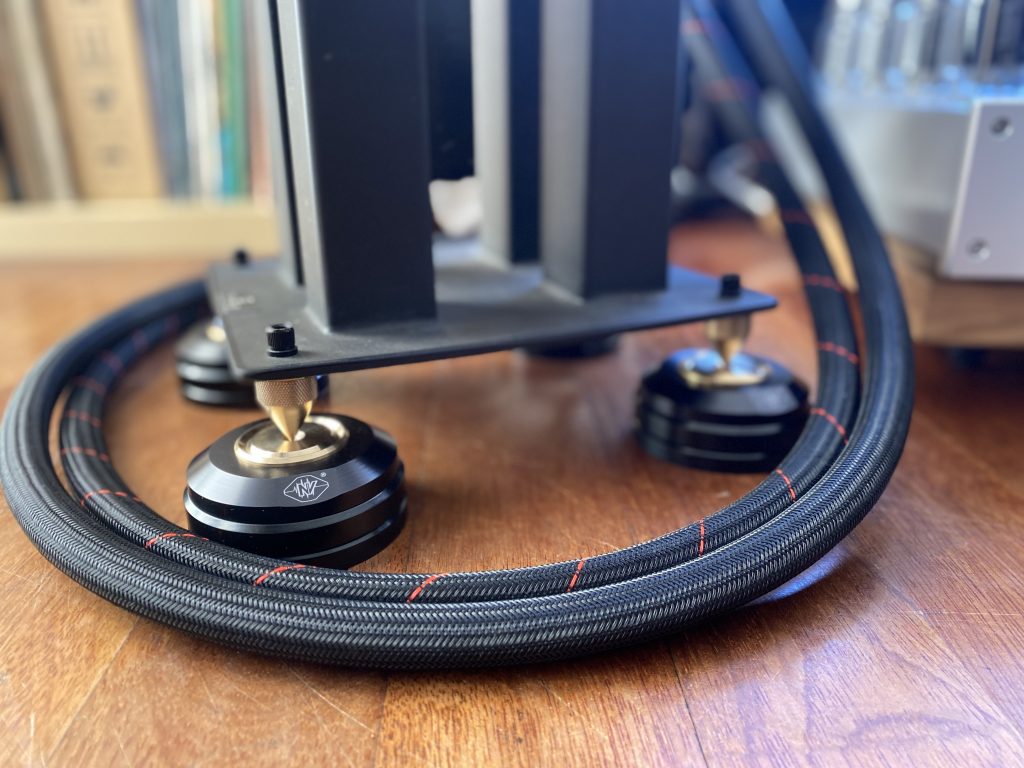
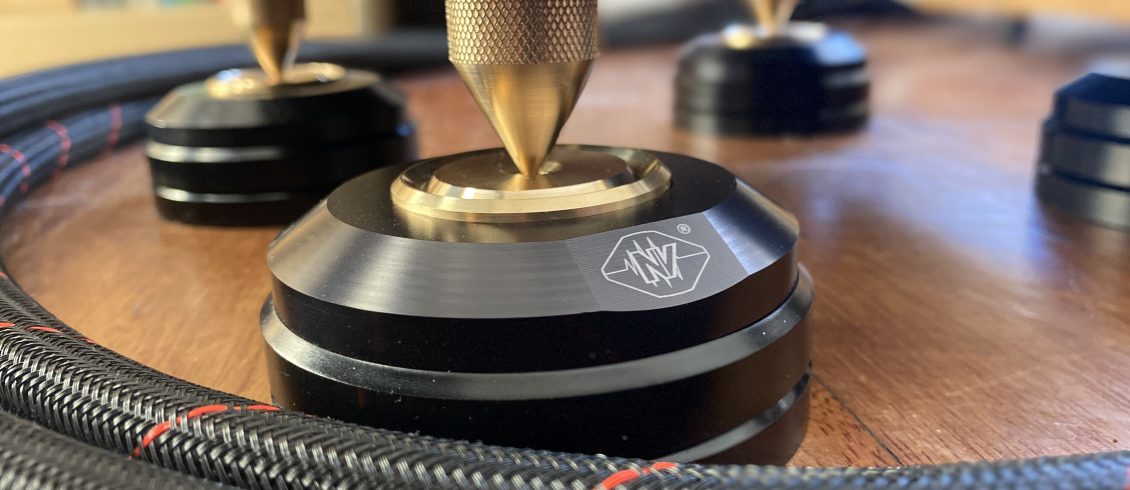
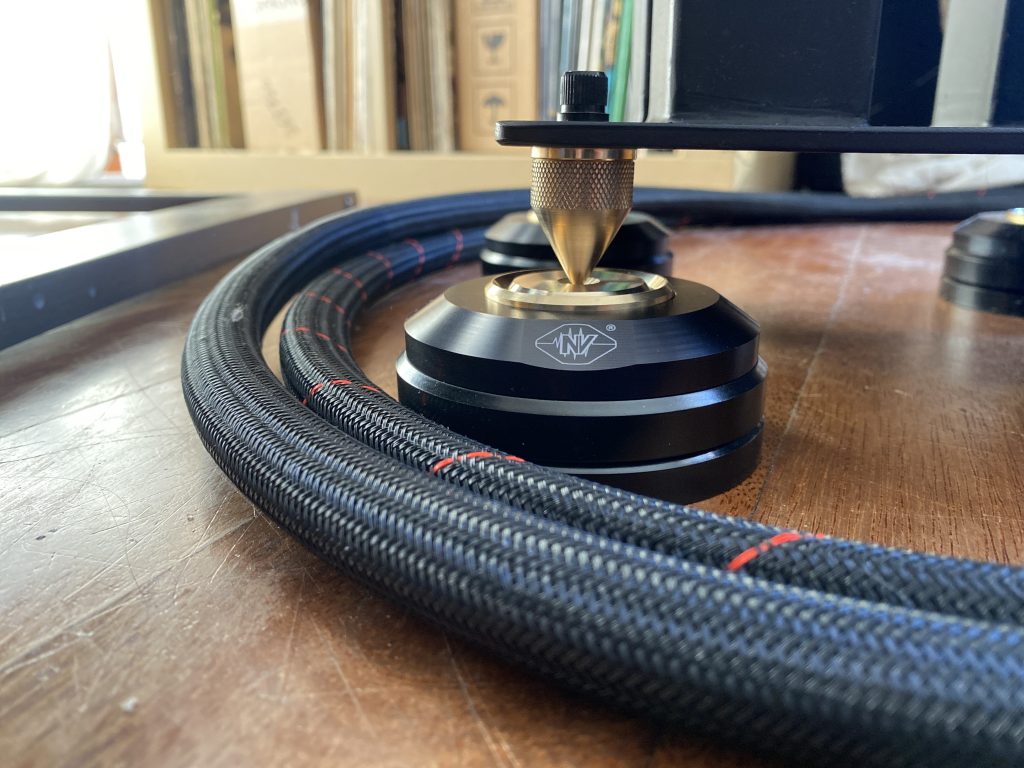
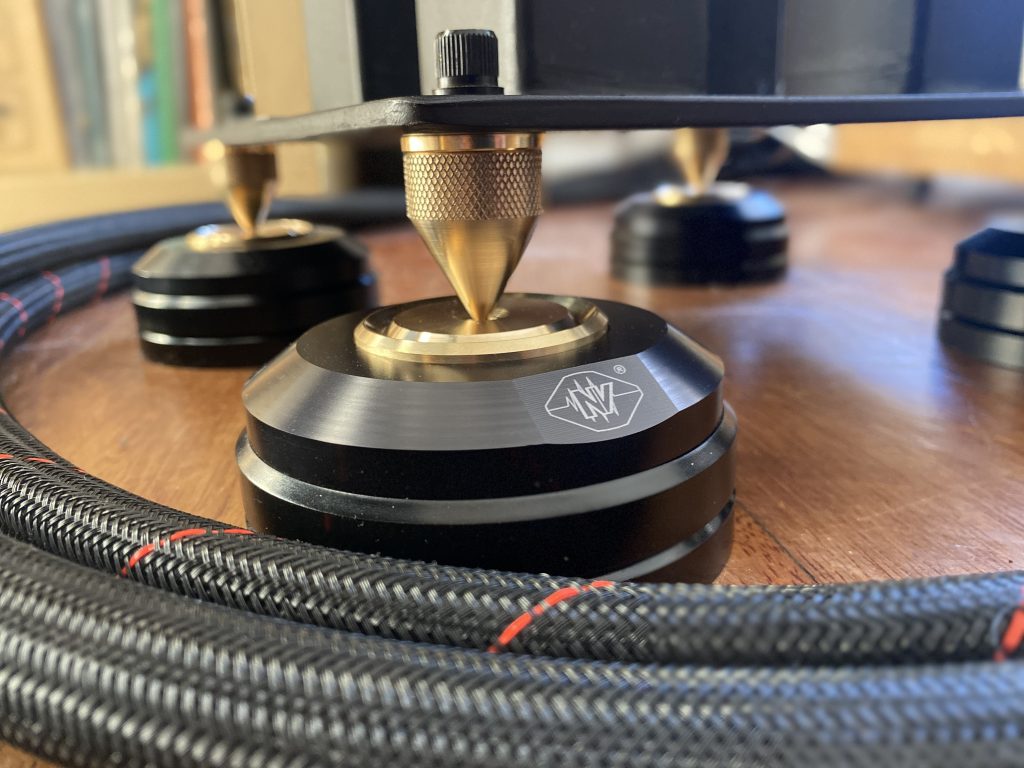
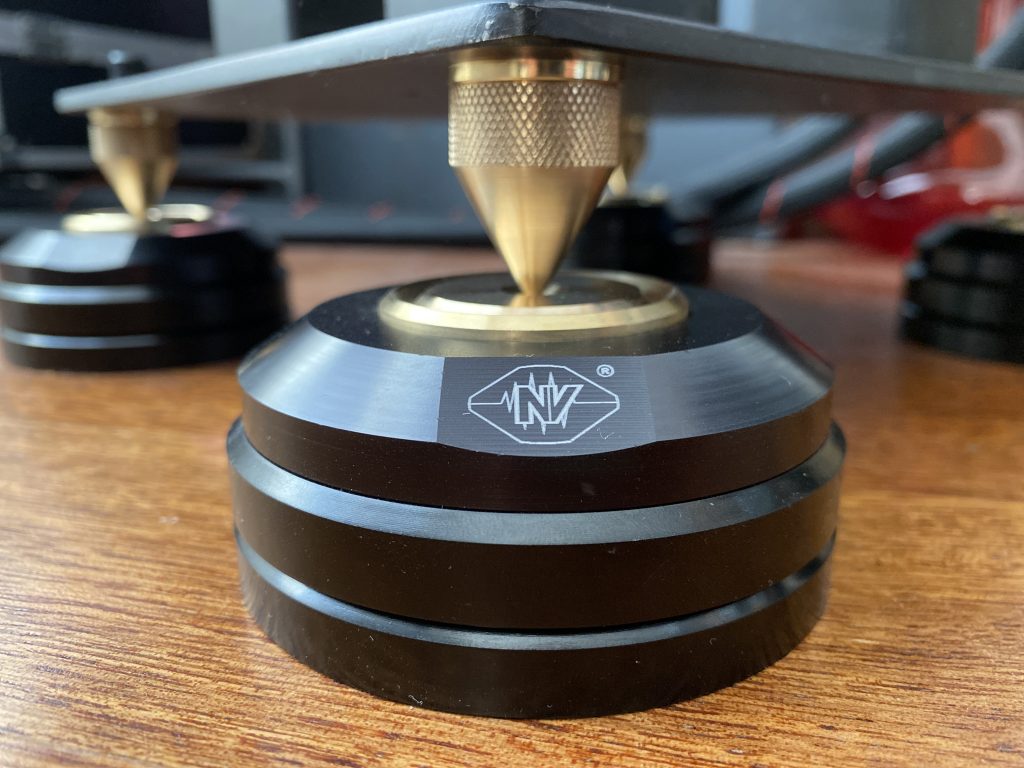
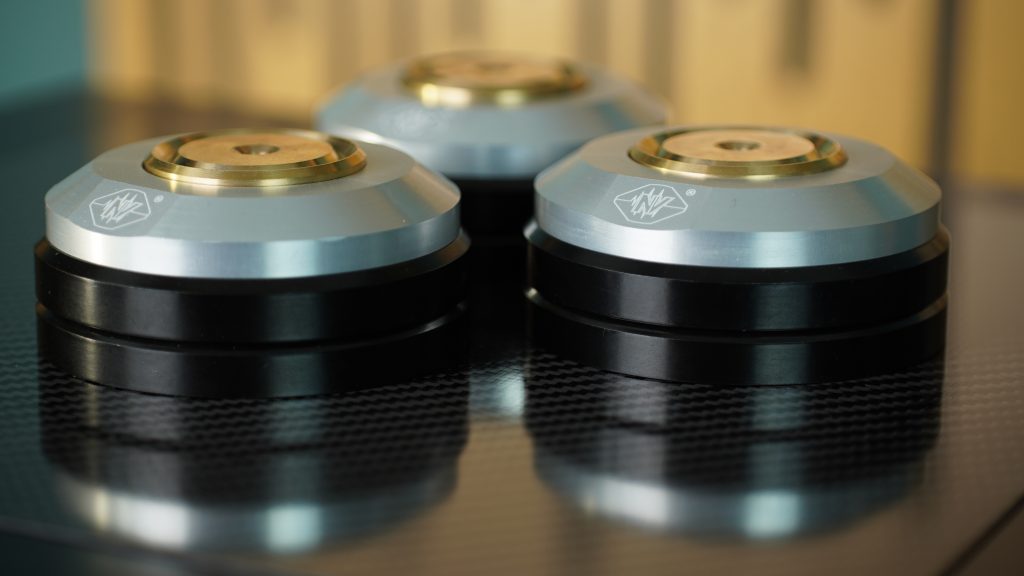
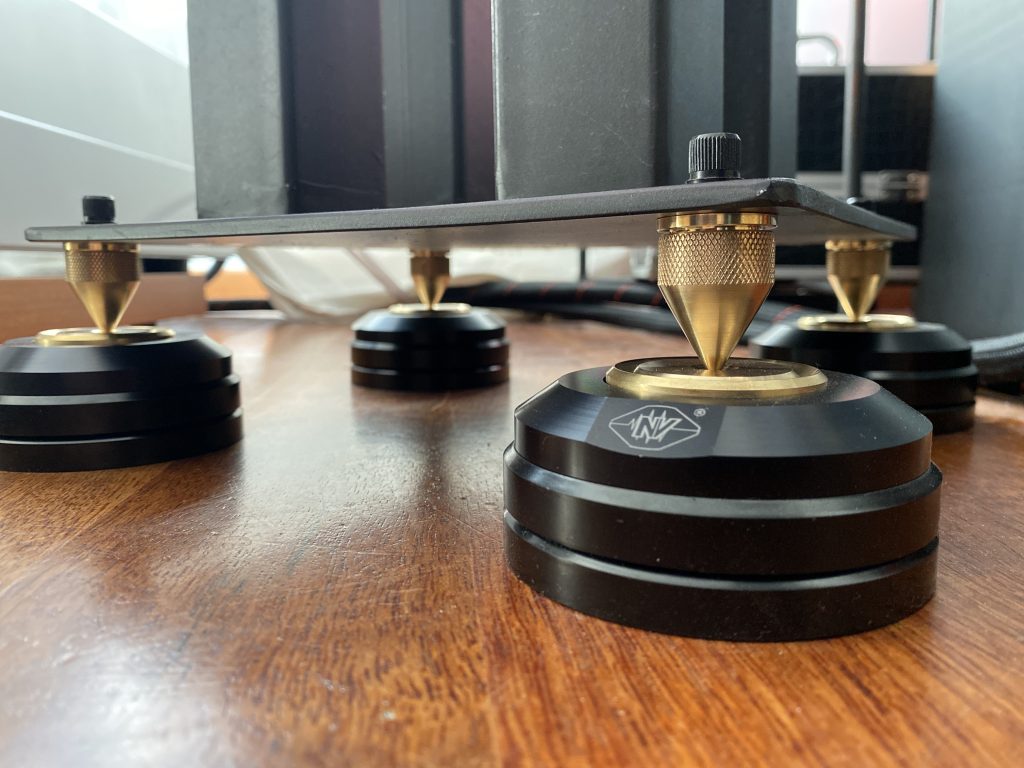
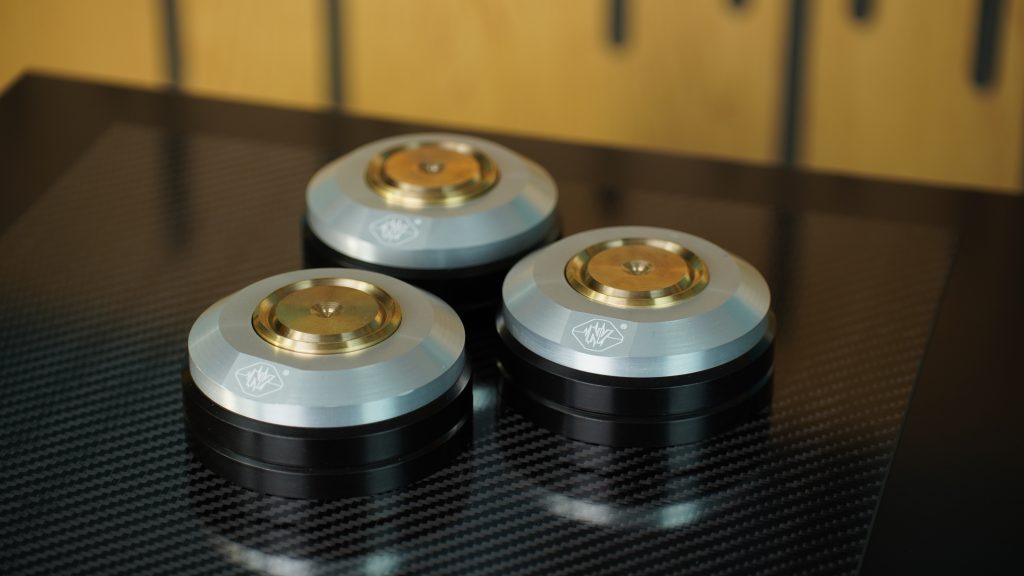
For this review, I received the BE42MZ vibration control supports and a set of MSWL spikes made from M-grade brass. The products are beautifully finished, although I should point out that they are not exactly small. The circular supports measure approximately 90 millimetres in diameter and, in my version, around 40 millimetres in height. The height varies between models because it depends on the amount of quartz used inside. The volume of quartz is selected in proportion to the weight of the equipment being supported. In my case, the supports were intended for my Falcon Acoustics LS3/5a loudspeakers together with their dedicated steel stands. So this review concerns a loudspeaker configuration. Along with the supports, I received a set of replacement membranes, an instruction manual, and the brass spikes, which the designer recommended as the best choice for this setup. During the first few days, however, I did not experiment with different membranes or settings. I simply listened. I wanted to understand what the supports themselves brought to the system in their standard configuration, without making any adjustments. Only after establishing that reference point could I begin to explore the possibilities of fine-tuning.
But one thing became clear almost immediately: these supports had a significant effect on the sound. It was not a small difference that required intense concentration to notice. The change was obvious. First of all, the presentation became noticeably cleaner. The background seemed quieter and more organised, as though the system was no longer wasting energy on internal mechanical vibrations. The bass gained both weight and control. I’m not talking about deeper bass extension or an artificial boost. It was more a sense of greater stability and a firmer foundation. The double bass, kick drum, and lower registers of the piano gained clearer definition and weight, without sounding slower. At the same time, the dynamics improved. The difference between piano and forte became more pronounced. Dynamic contrasts were stronger, and the system seemed to respond with greater speed and impact. Transients were clearer, while microdynamics — those small differences in articulation — became easier to hear. At one point, I even wondered whether the dynamics had become too direct, whether the system was revealing too much energy. But my impression was that energy previously lost through mechanical interaction with the floor was now becoming more apparent in the sound. The same was true of the upper frequencies, which are a sensitive area in my system. My setup is adjusted in such a way that any excess in this range becomes immediately obvious. But it is equally sensitive to a lack of energy. Too much energy in the upper midrange or treble creates tension. Too little takes away the sense of air and openness. And this is where I discovered that the vibration control provided by No Vibration does more than simply improve order and clarity. It also reveals things. Details that had previously been partly masked by mechanical interference became more directly audible. The result was a cleaner, considerably more dynamic, and more contrasting presentation. At that point, the question was no longer whether the difference was audible. That was beyond doubt. The question was whether this change was bringing me closer to the music. And answering that question required more time. This is why I decided to leave the fine-tuning for later.
The adjustment process itself is not complicated, but it does require time and careful listening. The manufacturer offers three different membrane stiffness options. They are made from the same material but differ in thickness. This allows the user to move one step towards greater rigidity or one step towards greater flexibility. The package also includes two types of dampers, primarily intended to help control the upper frequencies when necessary. Although the initial effect of No Vibration on my system was substantial, the adjustments themselves produced much smaller changes. This is fine-tuning rather than a complete transformation. Generally speaking, we can make the sound slightly firmer or a little softer. With greater stiffness, we gain clearer definition, especially in the bass, and a more precise attack. With greater flexibility, the sound becomes warmer, with gentler outlines and smoother transitions between different layers of the musical presentation. From my perspective, this stage of adjustment may be especially useful in those sensitive areas where a system is balanced between precision and excessive tension — or the opposite.
So, what is my final assessment? No Vibration is a carefully considered and mature concept. Its greatest strength is not simply the audible improvement, which in my system was significant, but the fact that it offers a complete approach to vibration control. It is a tool for adjustment rather than an accessory with one fixed effect. In my experience, the supports do not simply add colour or change the tonal balance in the way some vibration control accessories can. Instead, they allow the equipment to reveal more of its potential. The initial result was immediate: greater dynamics, better separation, and a cleaner presentation, without losing the energy or the sonic character of the system. Sometimes, as happened in my case, effective vibration control can also reveal weaknesses elsewhere in the audio chain. However, the modular design, with its interchangeable membranes and damping elements, gives the user a way to identify and address some of these problems. No Vibration is one of the best vibration control solutions I have experienced. Not only because it makes a clear difference to the sound, but also because it is an open and flexible system that can be adjusted to suit different components and audio setups. In my case, the results were convincing enough that No Vibration will remain part of my Audio Idiom reference system.

THE PRODUCT RECEIVES THE HARMONY AWARD FOR ITS COMPREHENSIVE APPROACH TO VIBRATION CONTROL AND ITS SIGNIFICANT IMPROVEMENT OF SOUND QUALITY IN AUDIO SYSTEMS.
.
© Marcin Oleś